Why the Moon Keeps the Same Face Toward Earth
Why the Moon keeps the same face toward Earth comes down to matched rotation and orbit. Use a simple marked-object model to see how the motion works.
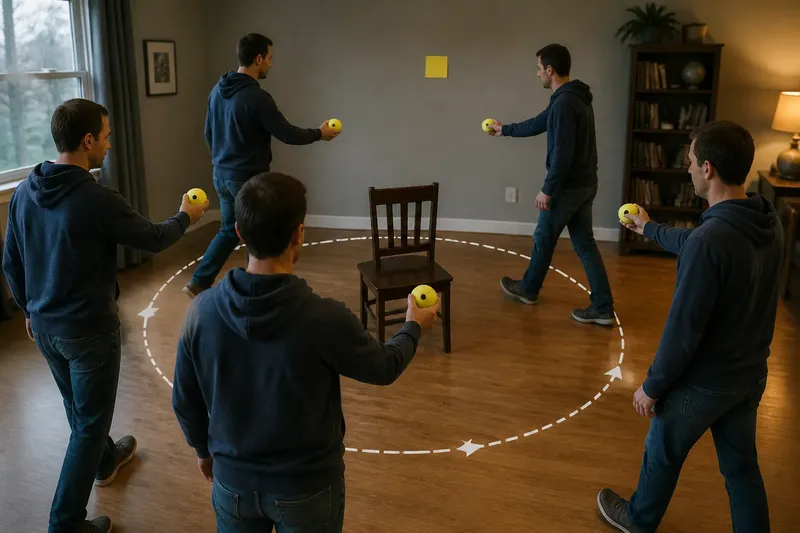
The most common mistake about why the Moon keeps the same face toward Earth is assuming it does not rotate. That costs you the central clue: the Moon turns on its axis as it travels around Earth, with the two motions matched. A marked ball and a chair can make the relationship visible without a telescope or sky map.
Rotation and orbit
Rotation is a body’s turn around its own axis. An orbit is its path around another body. The Moon completes one rotation during one trip around Earth, a pairing called synchronous rotation.
Try the model with a tennis ball and a chair. Treat the chair as Earth, choose the ball’s logo as the lunar mark, and start with the logo facing the chair. Walk around the chair while keeping the logo aimed inward. You will turn the ball as you go, even though the marked side continues facing the center.
That turn is easy to miss if you focus only on the ball’s face toward the chair. Watch the logo against a fixed feature in the room instead. Its direction changes as you move, then returns to its starting direction when you complete the circuit.
Follow the lunar mark
Use the same setup and check these points as you move. At each point, observe both the logo’s direction toward the chair and its direction against the room; let the result guide what you notice next.
- Starting point: Check whether the logo faces the chair. If it does, begin the walk; if it does not, turn the ball until it does.
- Quarterway around: Check whether the logo still faces inward. If it does, note that the ball has turned relative to the room; if it does not, adjust your grip so the logo faces the chair again.
- Halfway around: Check whether the logo points toward the chair while facing a different wall. If it does, compare the room direction with the start; if it does not, pause and reset the inward-facing orientation.
- Three-quarters around: Check whether the logo remains aimed at the chair as another part of the room comes into view. If it does, continue; if it does not, rotate the ball toward the chair before moving on.
- Back at the start: Check whether the logo faces the chair and points toward its original room direction. If both are true, you have completed one orbit paired with one turn; if not, repeat the circuit more slowly while tracking both directions.
- At any point: Check whether you are describing the logo relative to the chair or the room. If it is relative to the chair, you are tracking the Earth-facing side; if it is relative to the room, you are tracking rotation against a fixed background.
Say you start with a tennis ball’s logo facing a chair and place a sticky note on the wall behind you as a fixed room marker. You carry the ball halfway around the chair, keeping the logo aimed at it; the logo then faces the chair but points toward a different part of the room. You finish the circuit and it points toward the sticky note again. The resulting observation is one full turn relative to the room while the logo remains directed toward the center.
Near side and far side
The near side is the hemisphere generally turned toward Earth; the far side is generally turned away. “Far side” does not mean permanently dark. The Sun lights different parts of the Moon as it moves through its phases, so the far side also has periods of daylight.
Earth observers see nearly the same lunar hemisphere because the Moon’s inward-facing side stays broadly oriented toward us. The view is not perfectly fixed. The Moon’s orbit and motion allow its visible boundary to shift slightly, an apparent rocking called libration.
Libration lets observers see a little beyond the usual edge of the near side at different times. It does not bring the whole far side into view from Earth. Think of it like seeing a little more of a book cover as you shift your position, not turning the book all the way over.
Why does the view stay familiar?
Does the Moon rotate at all?
Yes. It turns on its axis as it completes its orbit around Earth. Without that rotation, different lunar sides would face Earth at different points along the orbit.
Why can’t I see the rotation from Earth?
The same broad lunar features remain directed toward Earth, so the view changes little compared with the Moon’s rotation against distant surroundings. The familiar face is the result of rotation matched to orbital motion, not a lack of turning.
Can I see any of the far side?
Libration exposes small areas beyond the usual near-side boundary at different times. It never makes the entire far side visible from an Earthbound viewpoint.
Does the far side stay dark?
No. The terms near side and far side describe the Moon’s orientation relative to Earth, not its illumination. The Sun lights the far side during part of the lunar day.
Choose a viewpoint
To keep the explanation straight, name the reference point you are using. From Earth, ask which lunar features face you; from a distant viewpoint, track a feature against the background of stars. The first view shows why the same regions remain familiar, while the second reveals the Moon’s turn during its orbit.
A lunar map or clear image can help you identify a surface feature, but it does not replace the reference-point distinction. Ask whether you are tracking the feature’s direction toward Earth or its direction against a fixed background. The Earth-facing direction stays broadly steady; the background direction changes as the Moon travels around us.
Where the model stops
The chair-and-ball model shows the basic pairing, but it does not reproduce every detail of the real system. The Moon’s orbit is tilted, and its position along that orbit affects the view from Earth. Those factors help explain why the visible face shifts slightly rather than remaining an identical disk.
Do not read “one turn per orbit” as “no movement.” The Moon’s orientation changes continuously. Matching its spin to its journey around Earth keeps the same hemisphere generally pointed inward, even as the viewing direction against the background changes.
When you look at the Moon, identify one familiar feature and ask what you are using as your reference: Earth or the distant sky. That small distinction is enough to see why the Moon keeps the same face toward Earth while still rotating.