The Brightest Star Is Not Always the One That Looks Biggest
Apparent brightness and apparent size describe different things. Learn how to tell a star’s visual prominence from the tiny point your eyes actually see.
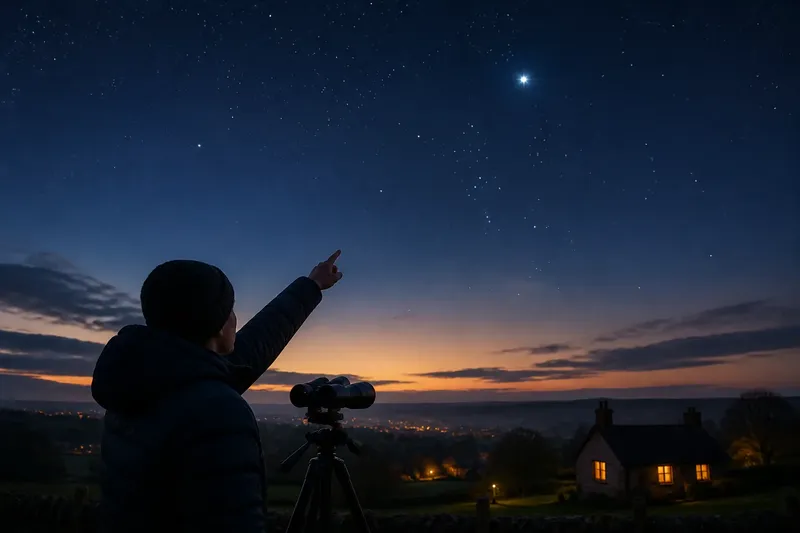
The common mistake is to call the most eye-catching star the biggest. That can lead you to confuse apparent brightness with apparent size, two different features that the naked eye does not reveal in the same way.
Stars usually look like points, even when one seems strikingly bright. Use these distinctions to read what your eyes are actually showing you.
1. Separate brightness from size
Apparent brightness describes how much light an object seems to deliver to your eye from where you are standing. Apparent size describes how much of your field of view the object seems to cover. A bright star can command attention without forming a visibly larger disk.
Think of a porch light and a distant window. The porch light may look more brilliant, while the window occupies a larger patch of your view. Light output and apparent size are not interchangeable clues.
For stars, apparent brightness is usually the feature you can compare unaided. Apparent size is much harder: a star’s visible point is affected by your eyes, the atmosphere, and the way its light spreads across the retina. It is not a straightforward picture of the star’s physical diameter.
2. Treat twinkle as a distraction
A star near the horizon often seems to flicker, flash color, or swell and shrink. Air moving through the atmosphere bends its light unevenly, and that changing light can make the point look restless. It does not mean the star is changing size.
Compare stars that are at similar heights in the sky, then look for a steady moment rather than judging during a strong flicker. If one point seems to flare, wait and look again. A brief flare is a poor basis for deciding that the star has a larger apparent disk.
Nearby buildings, branches, or rooflines can also frame a star in a way that makes it seem unusually prominent. Shift your gaze to a clear patch of sky before comparing it with another star.
3. Know what unaided eyes resolve
To the naked eye, most stars are unresolved points: their apparent disks are too small for your vision to distinguish as actual round surfaces. A star may look like a pinprick, a sharp point, or a fuzzy sparkle, but those impressions mostly describe the combined effect of its light and your viewing conditions.
Binoculars can make a star easier to locate and can reveal more surrounding stars, but they generally do not turn ordinary stars into obvious little disks. A telescope may show a larger point of light, yet that apparent enlargement is not a reliable way to compare stellar diameters. The instrument’s optics and the atmosphere shape the view.
There are exceptions among nearby objects in the sky, such as the Sun, which must never be viewed directly without appropriate certified solar equipment. That safety distinction does not make the Sun a useful naked-eye comparison for judging the apparent disks of distant stars.
4. Distinguish a star from a planet
A bright object that seems broader or steadier may be a planet rather than a star. Planets can show a small disk through suitable optical equipment, while stars remain point-like at ordinary backyard magnifications. To the naked eye, however, both can appear as bright points, so brightness alone may not identify what you are seeing.
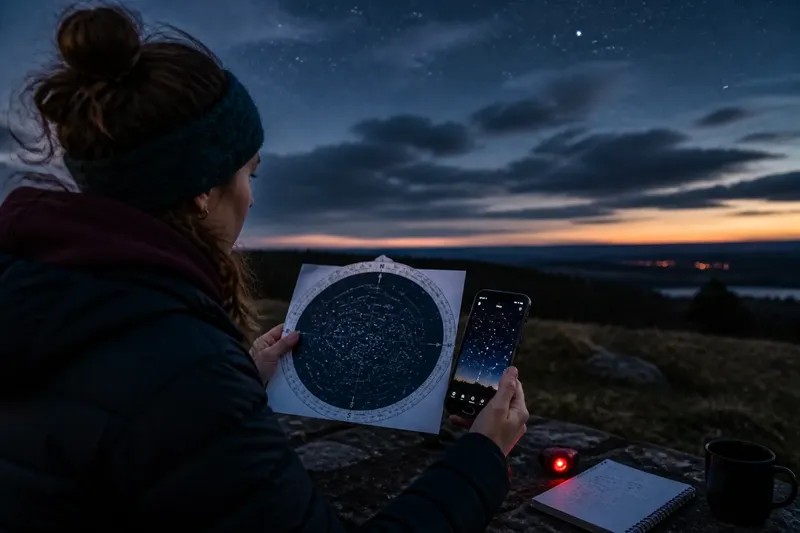
Notice the object’s position relative to nearby stars over multiple evenings. Planets shift against the background pattern; stars keep their positions relative to one another over a short observing span. A sky map or planetarium app can help identify the object, but check that its location and time settings match your observation.
This distinction matters because “brightest-looking point” is an observation, not an identity. A familiar bright object could be a planet, and calling it a star would confuse the object’s nature with its appearance.
5. Compare under steady conditions
To compare apparent brightness, choose a clear, dark location and let your eyes adjust. Avoid staring at a bright screen between glances. Look at a small group of stars together, then shift your gaze briefly and compare which points remain easiest to notice.
Say you are looking at a bright point above a roof and a fainter point in a clear opening. Move to an unobstructed spot and compare them again after a short pause. If the first point still seems more conspicuous, that supports a judgment about apparent brightness; it does not establish that its visible disk or physical star is larger.
Keep your comparison modest. Haze, thin cloud, nearby lights, and the height of each star can change how much light reaches your eyes. If conditions differ across the sky, postpone a close brightness comparison rather than treating a fleeting impression as a firm ranking.
6. Use the right description
When sharing an observation, describe what you can verify: “that star looks brighter from here,” or “this point seems to twinkle more.” Avoid saying “it is bigger” unless you mean that it occupies more of your view, and explain what you compared it with. Precise wording keeps an impression from turning into a claim about a star’s actual dimensions.
For a simple observing note, record the date and time, your location in general terms, the object’s height above the horizon, and the conditions you noticed. Then write whether you mean brightness, apparent size, or physical size. Those are separate questions, and a naked-eye view answers the first most readily.
What can you tell by sight?
Can a brighter star look larger?
It can seem more prominent, and its point may look more intense or spread out to your eye. That impression does not show that the star has a larger apparent disk or a larger physical diameter.
Why do some stars look like colored points?
A star’s light can give it a subtle color impression, while atmospheric turbulence can make colors flicker. Compare it when it is higher in a clear sky before treating a brief color shift as a stable feature.
Can binoculars show a star’s size?
Binoculars help you find stars and see their surroundings, but most stars remain unresolved points. A larger-looking point through optics is not a dependable measure of the star’s true diameter.
How should I describe the brightest-looking star?
Say it appears brightest from your observing spot, and name the conditions if they affect the view. Apparent brightness is a useful visual description; it is not the same as apparent size.
Next time a star catches your eye, ask whether you mean bright, broad, or physically large. That small distinction makes skywatching notes more accurate and helps you compare what you see without asking your eyes to reveal a size they cannot resolve.