A Cloudy Evening, Replanned as a Moon-Phase Sketch
A moon-phase sketch turns a cloudy evening into a useful record: separate the Moon’s visible shape from guesses about what clouds hide.
The common mistake on a cloudy night is to treat a missing view as a failed observing session. That can cost you the chance to notice how the Moon’s shape changes over time. A moon-phase sketch gives the evening a quiet purpose: record what you know, mark what you cannot see, and keep the two apart.
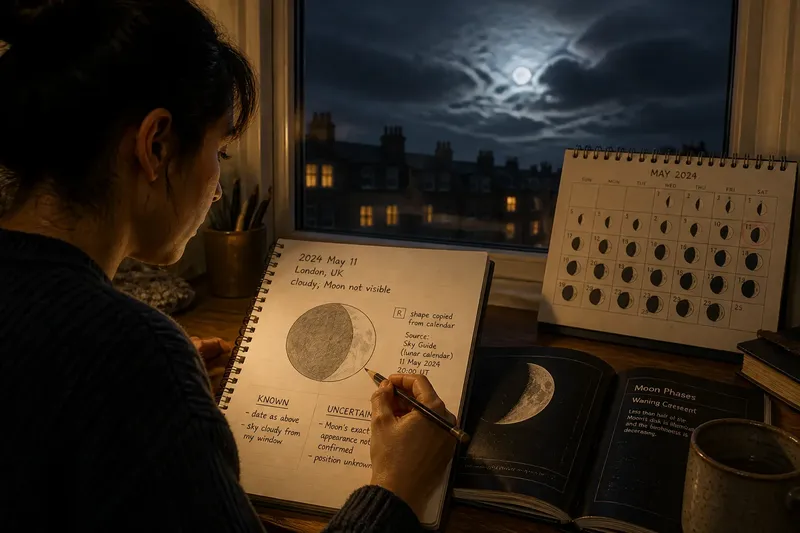
Imagine that a beginner named Maya has planned to look at the Moon from her apartment window, but a solid layer of cloud covers the sky. She still has a pencil, a notebook, and a moon-phase calendar nearby. Rather than drawing a detailed Moon from memory and calling it an observation, she decides to make a dated sketch with a clear note about its source. The result will be a record of her understanding, not evidence of what the clouds concealed.
A record, not a substitute
A Moon sketch can hold more than one kind of information. The outline of the bright portion may come from a reference, while the date and the weather come from the evening itself. If those sources are labeled, a future reader can tell which details were seen and which were supplied.
This distinction matters because a cloudy sky hides the Moon’s current appearance. A forecast, a calendar, or a memory may suggest what phase it is near, but none of those turns an unseen view into a direct observation. Write “reference” beside a shape copied from a chart, or “memory” beside one drawn from recollection. Save “observed” for details you actually saw.
Think of the notebook like a labeled storage box: a note on the outside prevents different contents from being mistaken for one another. Here, simple source labels protect the meaning of each mark on the page.
Maya’s first page
Maya begins by writing the date, her location, and “cloudy; Moon not visible.” She draws a circle to represent the Moon’s full disk, then checks a trusted lunar calendar to estimate the phase for that date. The reference suggests a waning crescent, so she shades most of the disk and leaves a narrow bright arc.
Before she closes the notebook, she adds “shape copied from calendar” beside the drawing. She does not write that the Moon looked like that through the clouds. Nor does she add a cloud outline over the disk as if she knew where the clouds lay relative to it. Her page now records a useful estimate and an honest limit.
The sketch does not need to be an accurate piece of astronomical illustration. Its job is to make the illuminated portion easy to compare from one entry to another. Maya uses the same circle size each time and shades the part she believes is dark. A consistent, simple shape is more useful for tracking a pattern than a highly detailed drawing with unclear sources.
Keeping clues separate
Cloud cover creates a temptation to fill gaps. A bright patch in the clouds might seem to suggest the Moon’s position, or a remembered view from the previous evening might feel close enough to copy. Those details can be recorded, but they should not be promoted into facts about the hidden view.
Maya makes a small “known” and “uncertain” note under her sketch. Under known, she writes the date and that the sky was cloudy from her window. Under uncertain, she writes that she cannot confirm the Moon’s exact appearance or position. This does not diminish the page; it tells her what kind of confidence to place in it.
If she notices a bright opening in the cloud, she can describe its location in ordinary terms, such as “thin gap above the rooftops.” She should avoid claiming that the Moon was behind it unless she actually sees the Moon there. A description of the visible cloud is still an observation, even when the Moon remains hidden.
Choosing a reference
For a sketch based on a reference, Maya needs a source that gives a phase for the relevant date and makes clear whether its display is local or universal time. A printed calendar, a reputable planetarium app, or an astronomy almanac can help. She records which one she used, since different displays may round times or show the phase at a particular moment.
She also checks whether the graphic shows the Moon as an illuminated disk or as a simple phase symbol. A small icon may be designed for quick recognition rather than faithful orientation. Maya treats it as a guide to the broad shape, not as a promise that the bright side will face the same direction from her window.
Orientation can depend on where and when the Moon is viewed, and a reference image may use a standard presentation. If Maya wants to draw the apparent direction of the crescent, she can wait for a clear view and note the direction from her own location. Until then, she leaves the orientation out rather than guessing.
What does a cloudy sketch tell you?
Can I sketch the Moon from memory?
Yes, if you label the drawing as a memory rather than a current observation. Add when you last saw the Moon, if you remember, and leave uncertain details unfilled.
Can a phase calendar replace a direct view?
A calendar can provide a reference for the phase on a date, but it cannot show what was visible through a particular patch of local cloud. Mark the calendar as your source and keep local weather notes separate.
Should I draw the clouds over the Moon?
Draw clouds only as you actually see them, such as a visible bank or gap. If the Moon itself is hidden, do not place it behind a specific cloud unless you have a direct view supporting that placement.
What if I do not know the phase?
Leave the disk blank or write “phase uncertain” until you can check a suitable reference. An incomplete page is more useful than a confident-looking shape with no clear basis.
Comparing the next view
On a later clear evening, Maya can look at the Moon and make a separate sketch labeled “observed.” She notes the time, viewing place, and any feature she can confidently distinguish, such as a crescent or a broad illuminated half. If haze or buildings obscure part of the view, she marks that limit instead of completing the outline from expectation.
She then places the clear-view sketch beside the cloudy-night entry. The two pages answer different questions. The first shows what a reference predicted or what she remembered; the second records what she saw. Any difference may come from the timing, the source image, the drawing, or the viewing conditions, so she avoids treating one comparison as proof that the other was wrong.
Over repeated entries, Maya can keep the same scale and a small notation key: “O” for directly observed, “R” for reference, and “M” for memory. She writes the key inside the notebook cover so it remains clear later. If a source changes or she corrects an earlier drawing, she adds a dated note rather than quietly replacing the original.
A useful cloudy-night habit
Maya’s first cloudy-night page is modest: a date, a weather note, a phase sketch based on a named reference, and a clear statement that she did not see the Moon. That is enough to make the session worthwhile without pretending the sky gave her a view it did not.
For your own moon-phase sketch, decide first whether you are drawing from sight, memory, or a reference. Put that source beside the image, record what the clouds actually looked like from your observing place, and leave hidden details unresolved. When the Moon returns to view, make a fresh observation rather than editing the cloudy-night page into one. The distinction is small on paper, but it is what turns a pleasant indoor activity into a trustworthy record of how you learned to read the sky.